
Geometry
On this page
You may or may not see geometry in Quantitative Reasoning questions on Test Day. It appears occasionally in official practice, so you will want to practise geometry to ensure you can answer with speed and accuracy.
As you revise, you will see that the UCAT does not include geometry formulae for the most common shapes. Thus, you must ensure you have a solid grasp of these shapes, along with any geometry concepts that will help you work with complex shapes in case these appear on Test Day.
As you revise geometry, it helps to think in terms of two-dimensional and three-dimensional shapes.
The same common shapes have appeared again and again in UCAT practice questions over the years, so these common shapes are most likely to appear on Test Day.
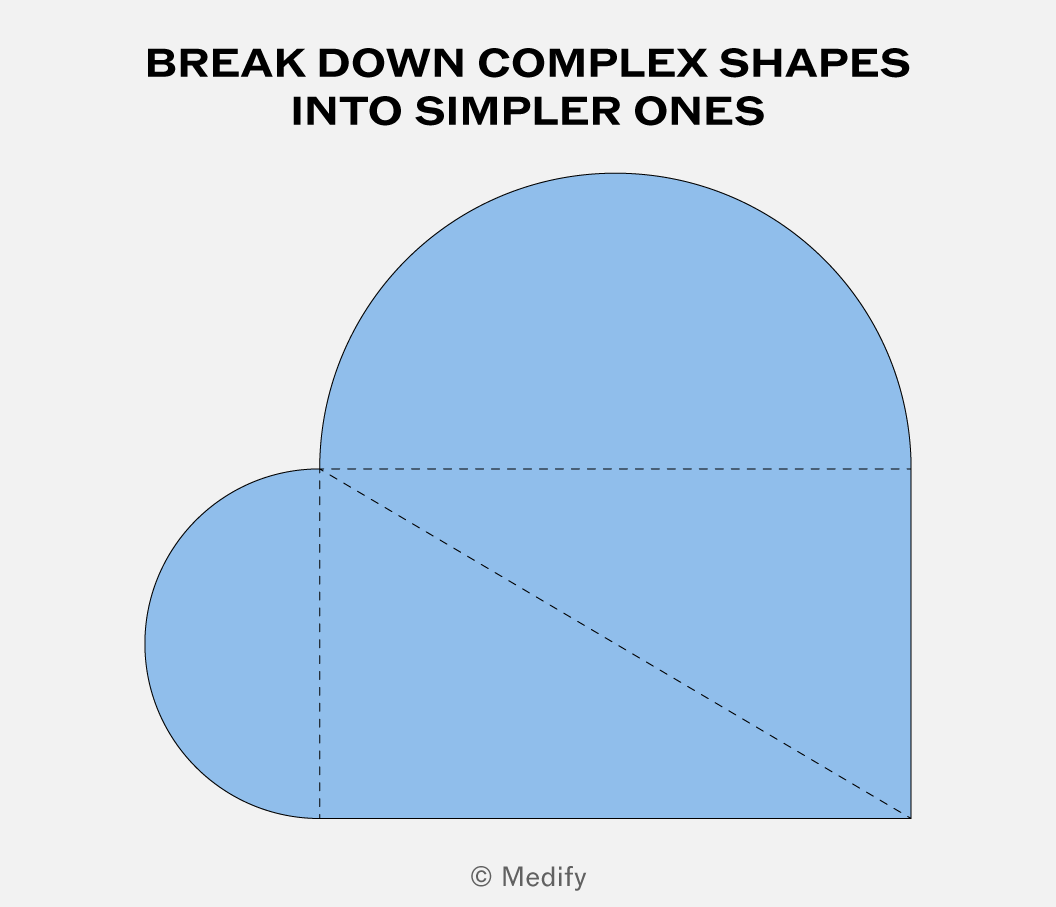
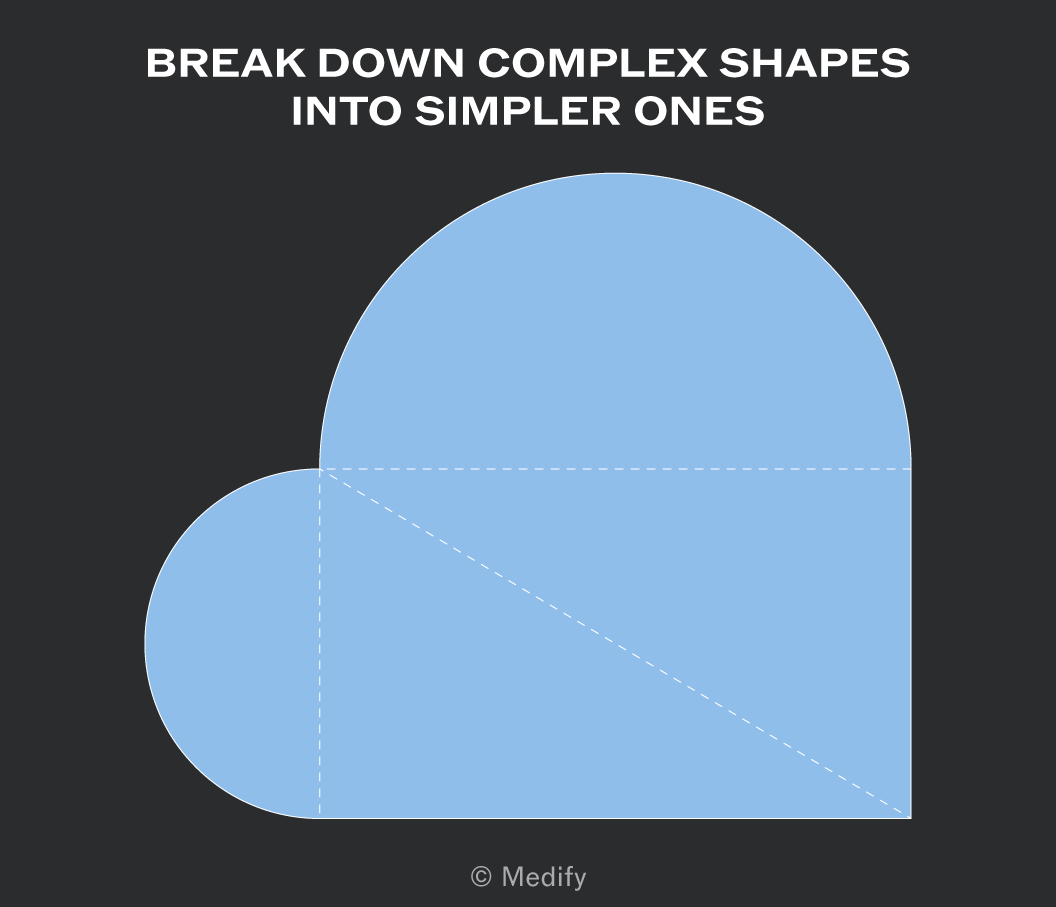
You can normally break down complex shapes into simpler, common shapes. This means that you do not need to memorise more obscure formulae. Most likely:
- The UCAT will provide the formula as part of the QR data.
- You can use common shapes to work with components of a complex shape.
Circles are a simple and powerful shape because the common formulae are all defined in terms of the radius.
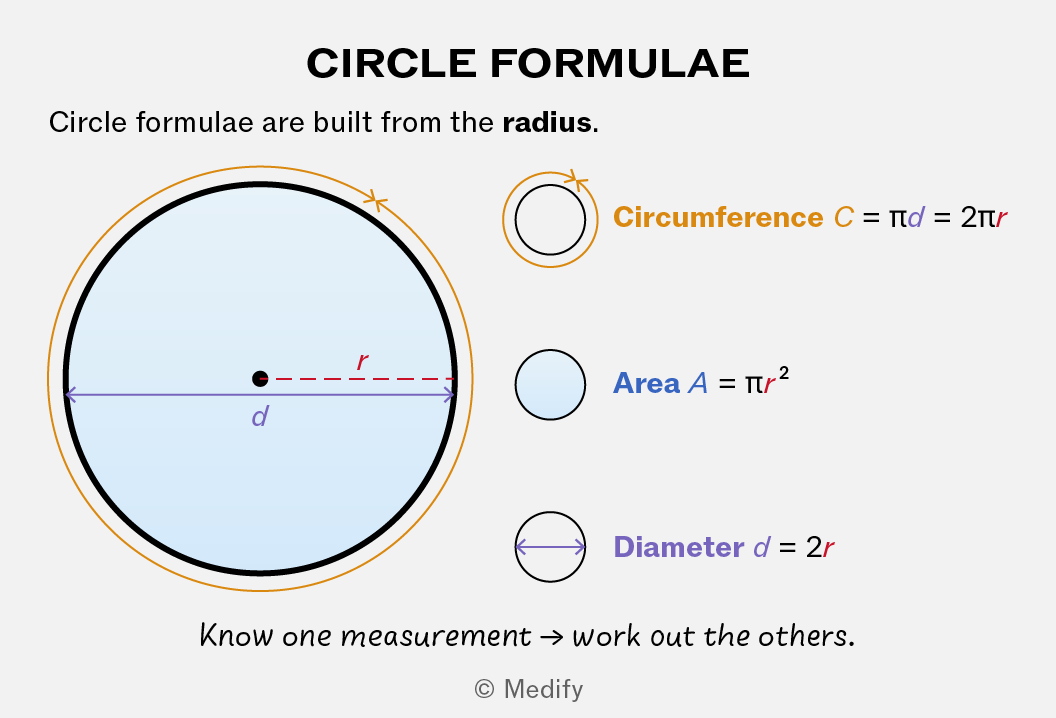
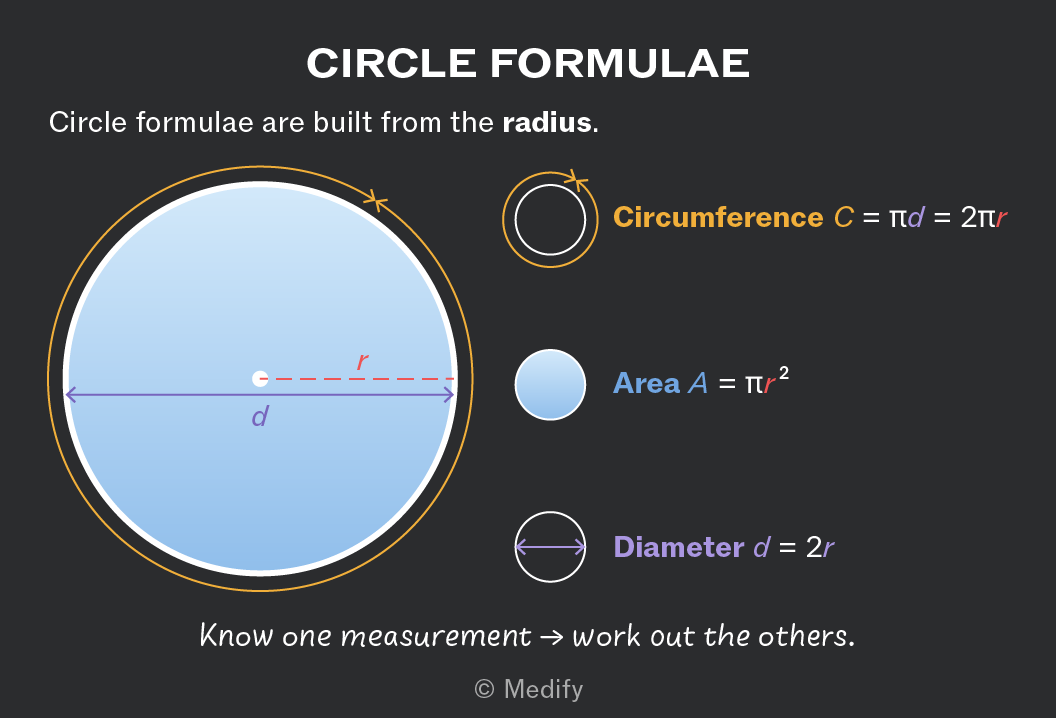
The UCAT may or may not tell you the value of pi (π).
- If the value of pi is given, use that value. Most commonly, it will be 3.14, though it could have additional digits or be given as a fraction, such as
- If the value of pi is not provided, use 3.14 and this will lead you to the correct answer. Further digits are unlikely to be significant in distinguishing among the answer choices.
Do not worry about arcs or chords, as these have never appeared in official UCAT practice materials and are unlikely to appear in the actual UCAT.
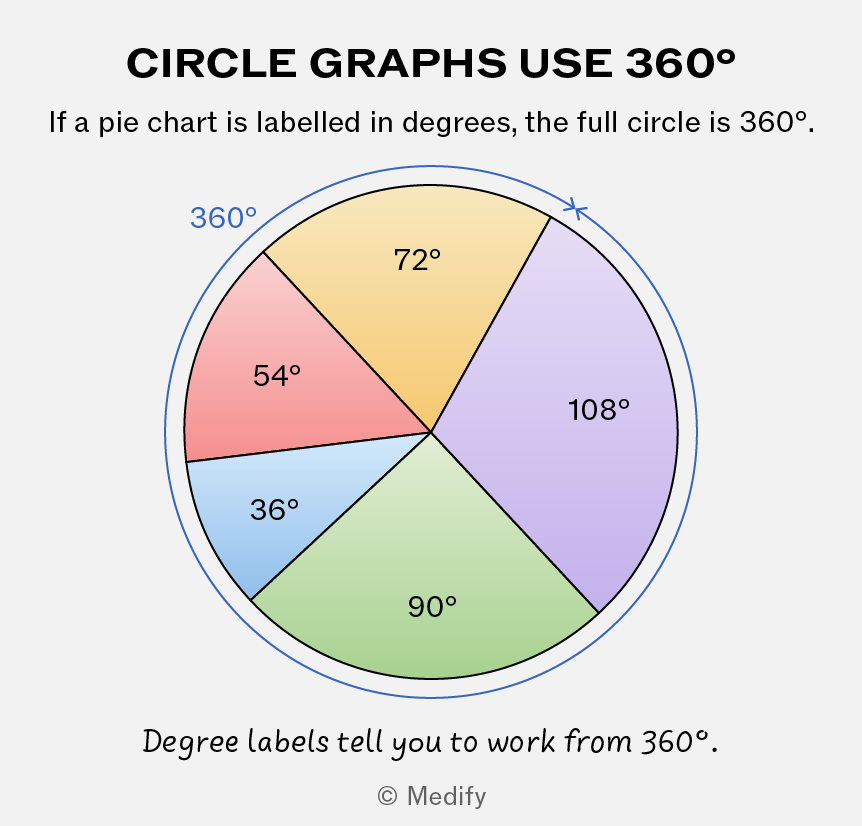
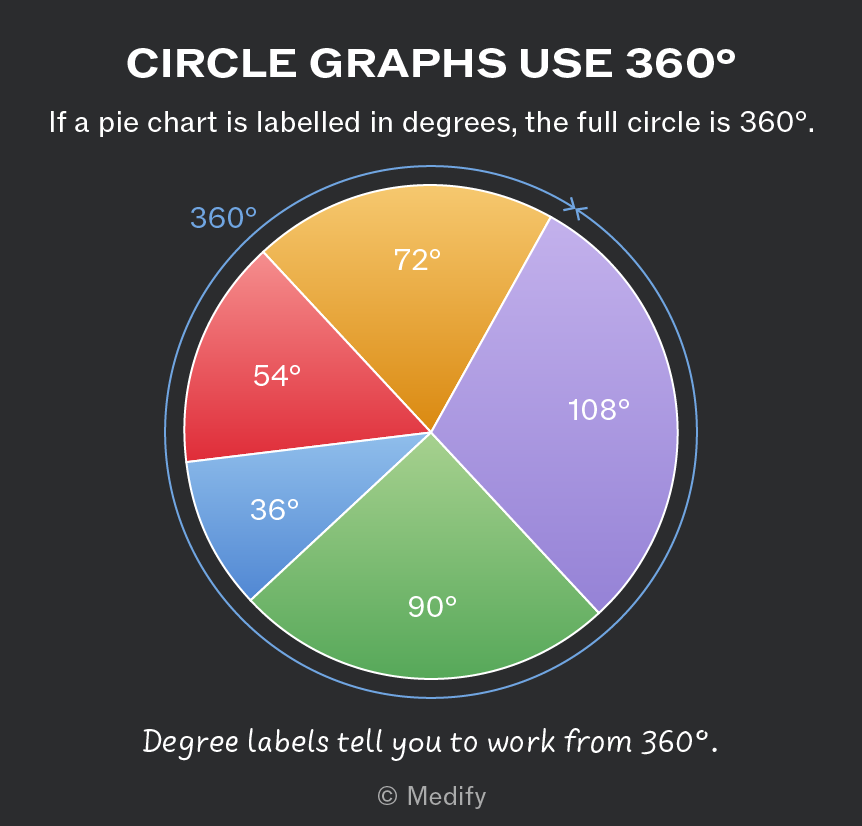
The same applies for segments of a circle, though you may need to work with portions of a pie chart. In a pie chart, the relative area of each portion corresponds to its proportional share of the whole amount.
Thus, you can think of each pie chart segment as a partial percentage (out of 100%) or a fractional share (out of 1).
When the UCAT presents a pie chart labelled with degrees (e.g. 72°) and calls it a circle graph, the whole amount of the pie chart is 360°.
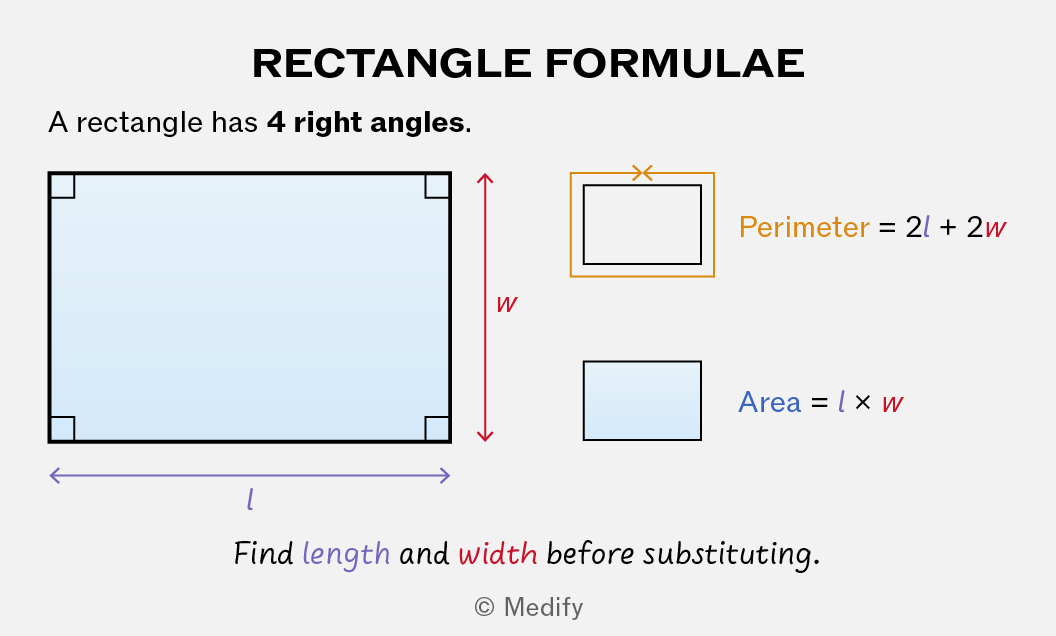
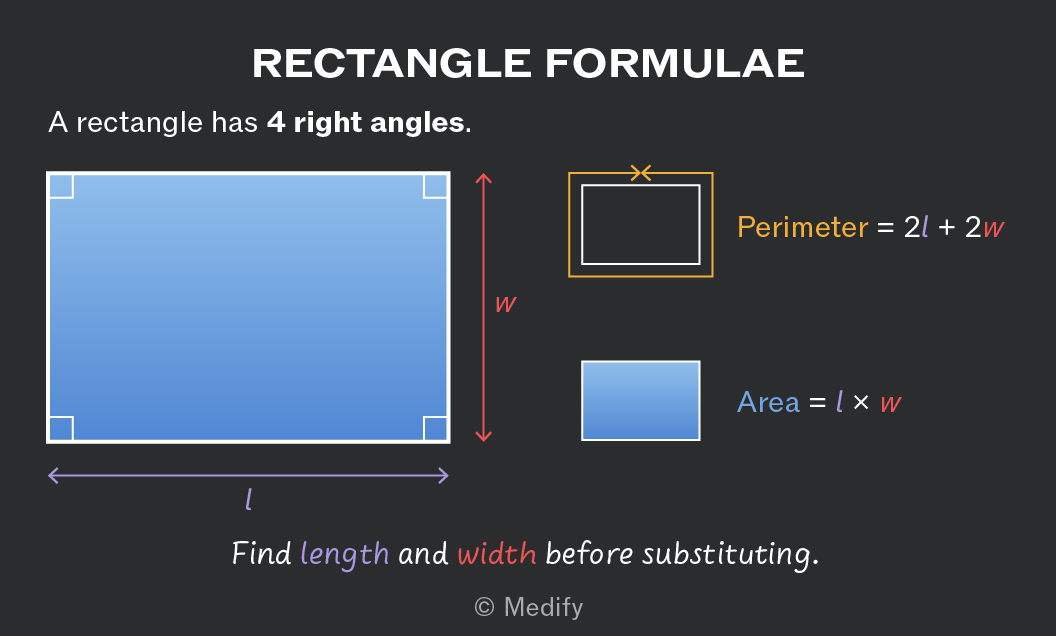
Rectangles are the most common quadrilateral you may see in Quantitative Reasoning.
Remember that a square is a type of rectangle as it fits the definition. However, a square’s length and width are equal.
Walkthrough question
Circles and rectangles
Try and tackle this geometry question involving common shapes.
Triangles are another simple and powerful shape as they can unlock geometry questions whether as an individual shape or part of a larger shape.
You should not need trigonometry on Test Day as it has never appeared in official UCAT practice questions.
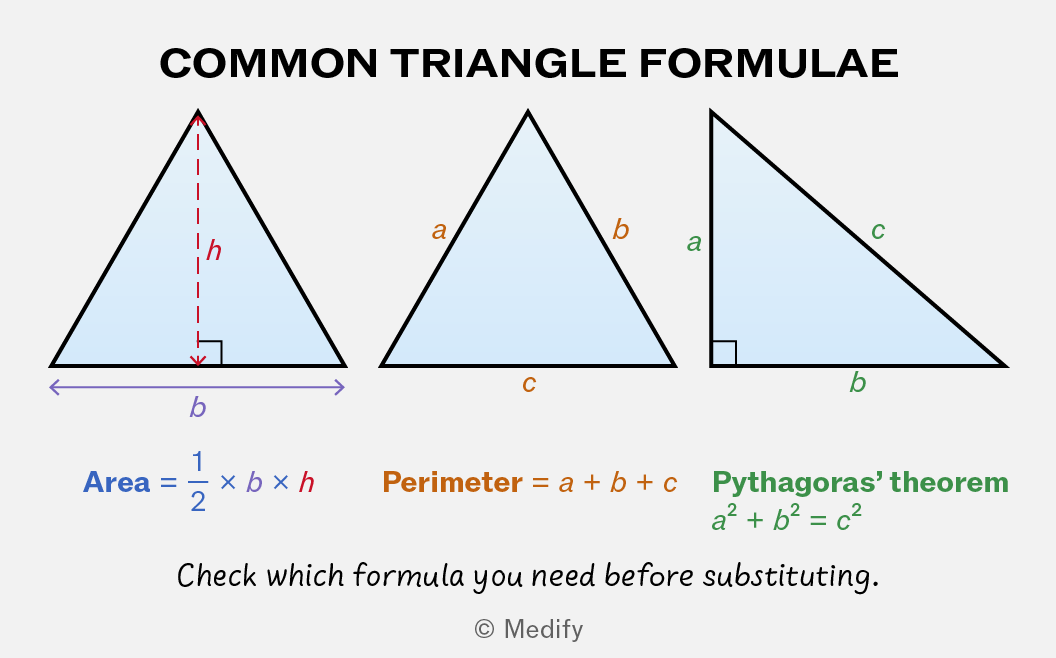
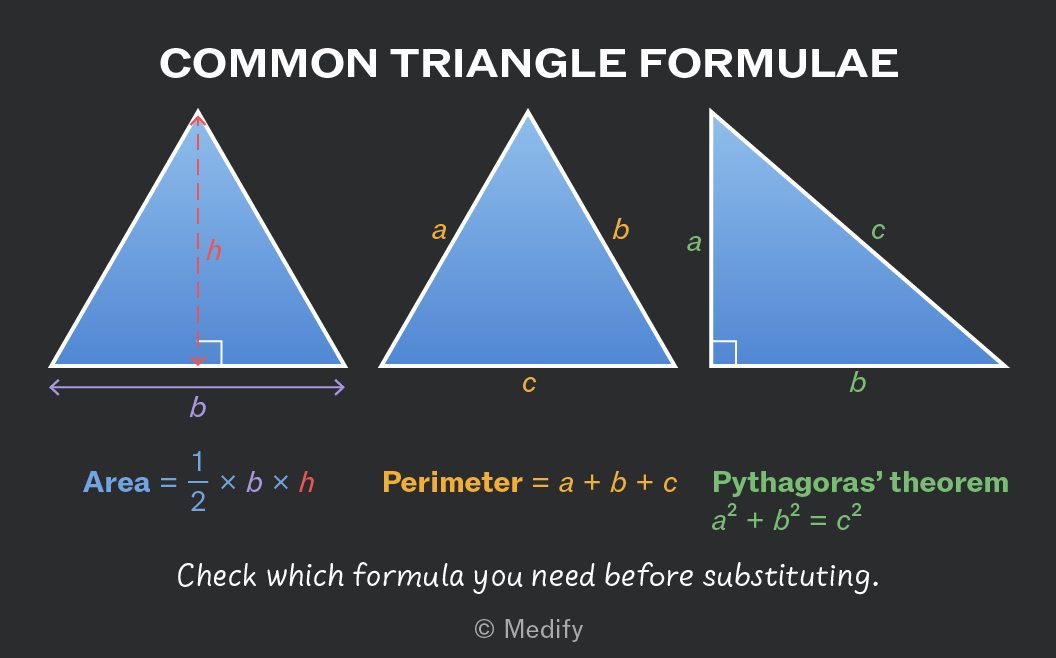
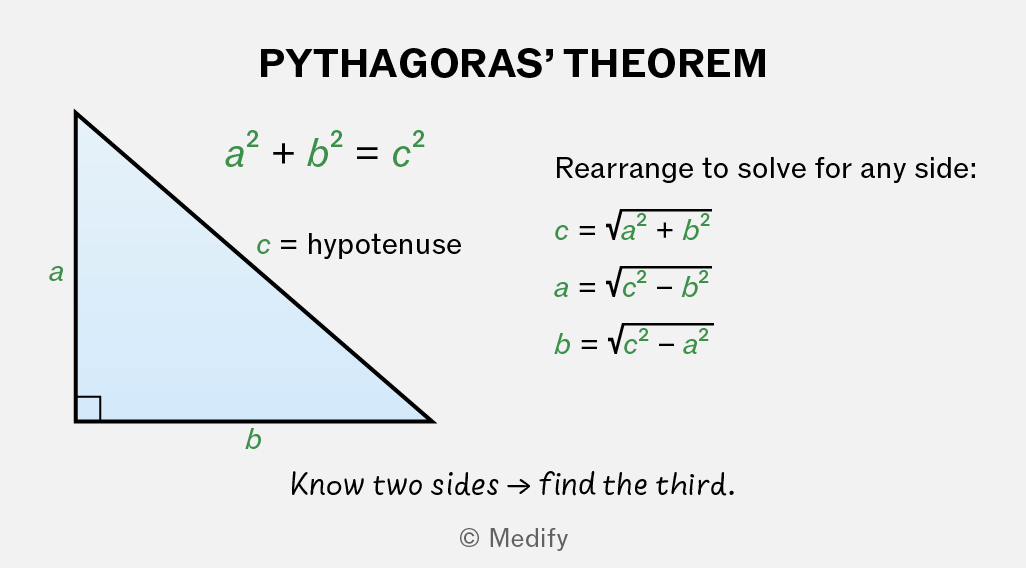
Use Pythagoras’ theorem (a2 + b2 = c2) to find any unknown side of a right-angled triangle when you know two other sides. In this theorem, c is the hypotenuse – the longest side.
Some more challenging questions may require you to use both the area formula and Pythagoras’ theorem to solve for an unknown.
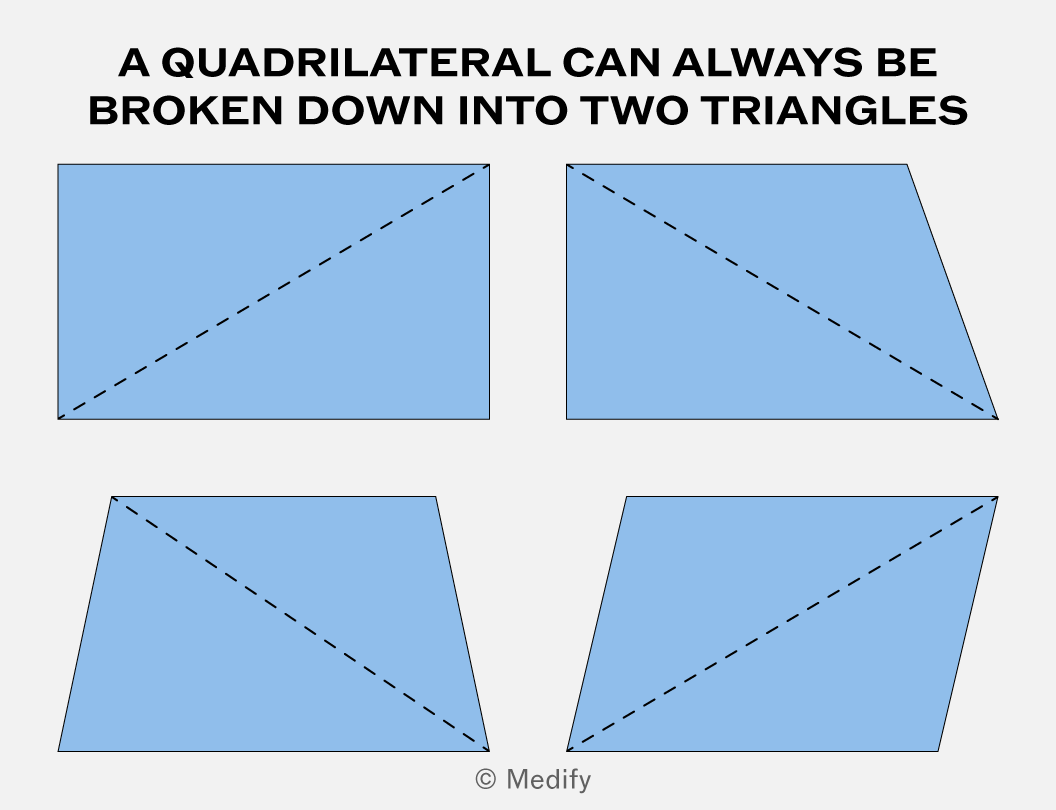
You can divide any quadrilateral into two triangles by drawing a straight line to connect two non-adjacent vertices (or ‘corners’).
This approach can turn any shape with four straight sides into a triangle question, allowing you to use all triangle properties and formulae that might be relevant.
Any rectangle divides into two equal triangles with the same area and same perimeter.
When you divide a rectangle into two triangles:
- Area of the rectangle = l × w
- Area of two equal triangles =
- Each triangle is one-half the rectangle’s area. You have two ways to solve:
Watch out for hidden rectangles and triangles which might be described in text in data or questions without a diagram.
Walkthrough question
Triangles
Let's practice a geometry question using challenging data.
You are less likely to see unusual two-dimensional shapes in Quantitative Reasoning. Should other polygons appear on Test Day, remember these key facts:
- The perimeter of a polygon is the sum of the lengths of its sides.
- The area of a polygon equals the area of smaller shapes it is made of.
- It will generally be quicker and simpler to break a complex figure into smaller shapes, then calculate the areas of the smaller shapes. The UCAT will usually allow you to divide complex shapes into triangles, rectangles, squares or circles.
If you see a complex shape or an unusual formula that might require two-dimensional geometry, ask yourself:
- What common shape could I use to solve? Think in terms of circles, squares, rectangles or triangles.
- How can I use geometry formulae or common shape properties (like area, perimeter/circumference, sides of a shape or hypotenuse of a triangle) to find the path to the correct answer?
- Do I have to work backwards or reverse the normal logic to solve?
Three-dimensional shapes are far less frequent than two-dimensional shapes in Quantitative Reasoning.
Unusual 3D shapes are highly unlikely to appear, though in theory the UCAT could provide a formula to use with an unconventional shape.
You will not need to use calculus or complete advanced maths involving 3D shapes in the UCAT. Only fairly basic concepts are involved.
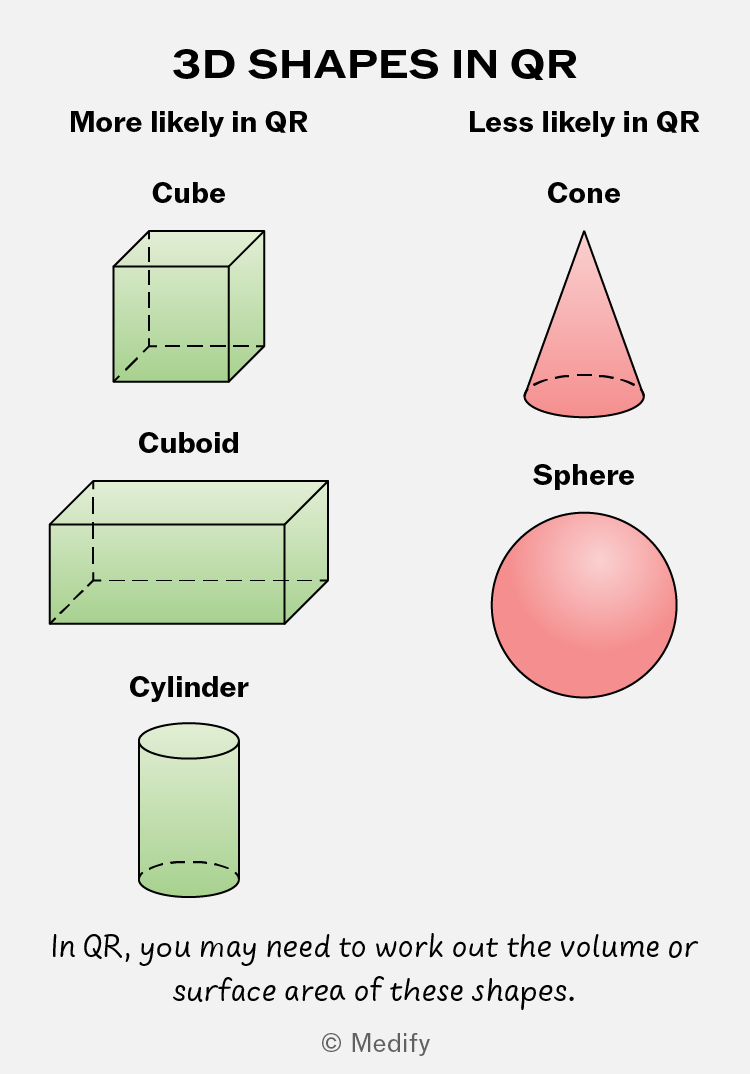
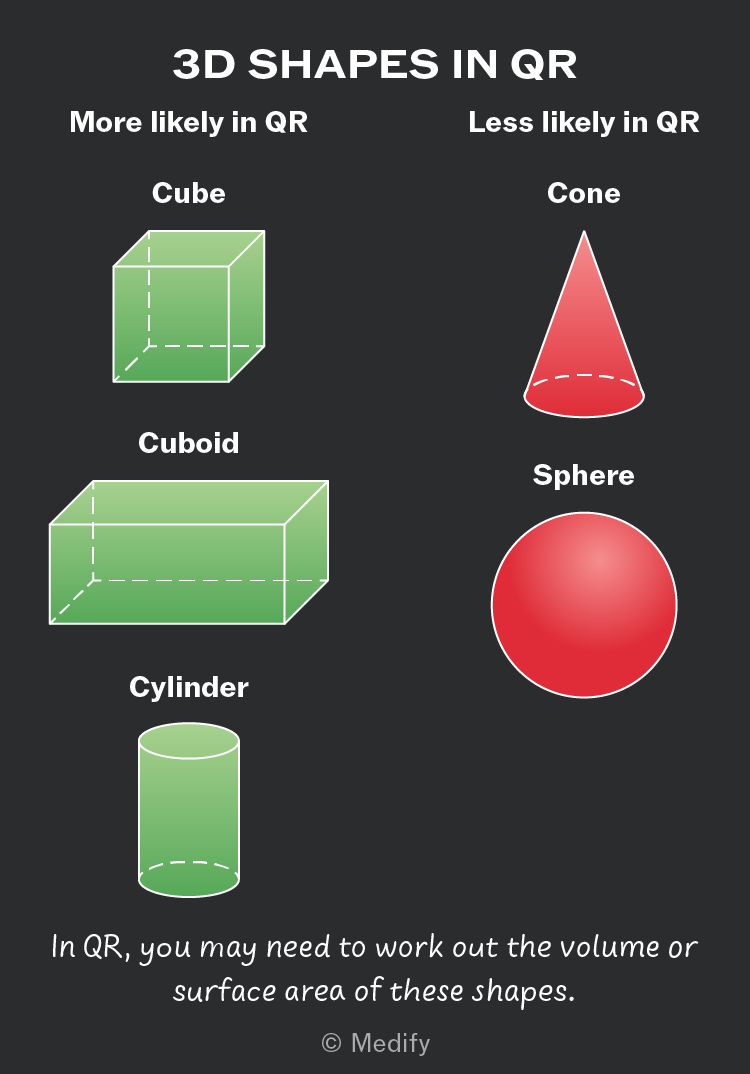
The volume of a three-dimensional shape is simple to calculate if the 3D shape is a prism.
A prism is a solid shape with a cross-section consistent in size and shape throughout the solid’s height. This cross-section is therefore the prism’s base.
To find the volume of a prism, multiply the area of the base by the height.
This rule is handy for conventional prisms like cubes, cuboids and cylinders. It can also help with unusual prisms, such as triangular prisms. Note that with a triangular prism, the longer side is called the length to distinguish from the base and height of the triangular cross-section.
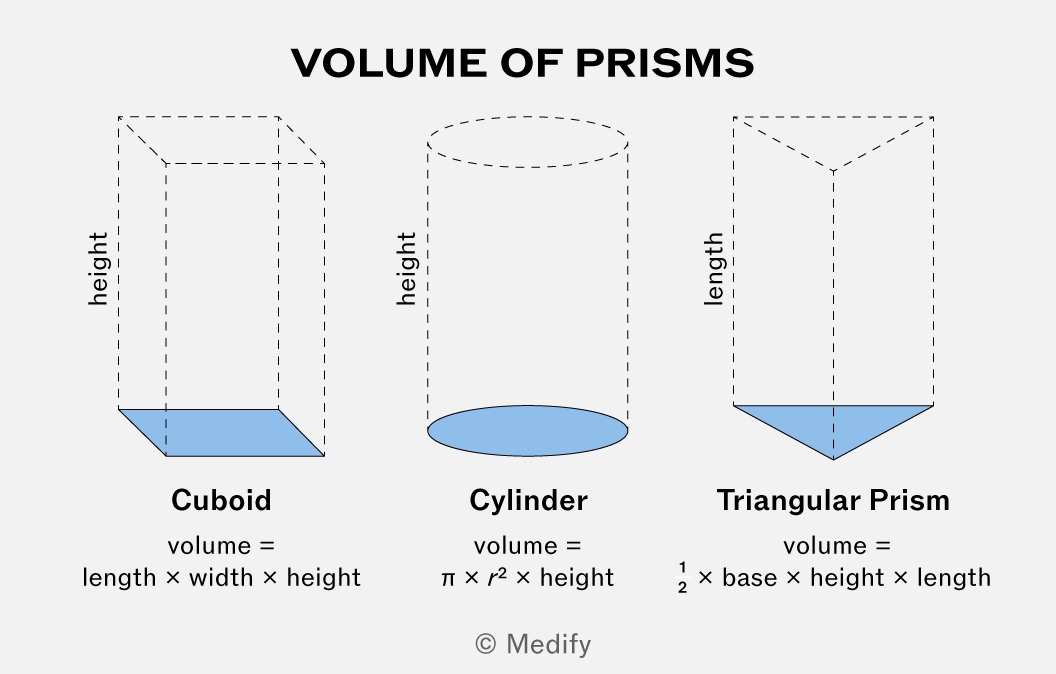
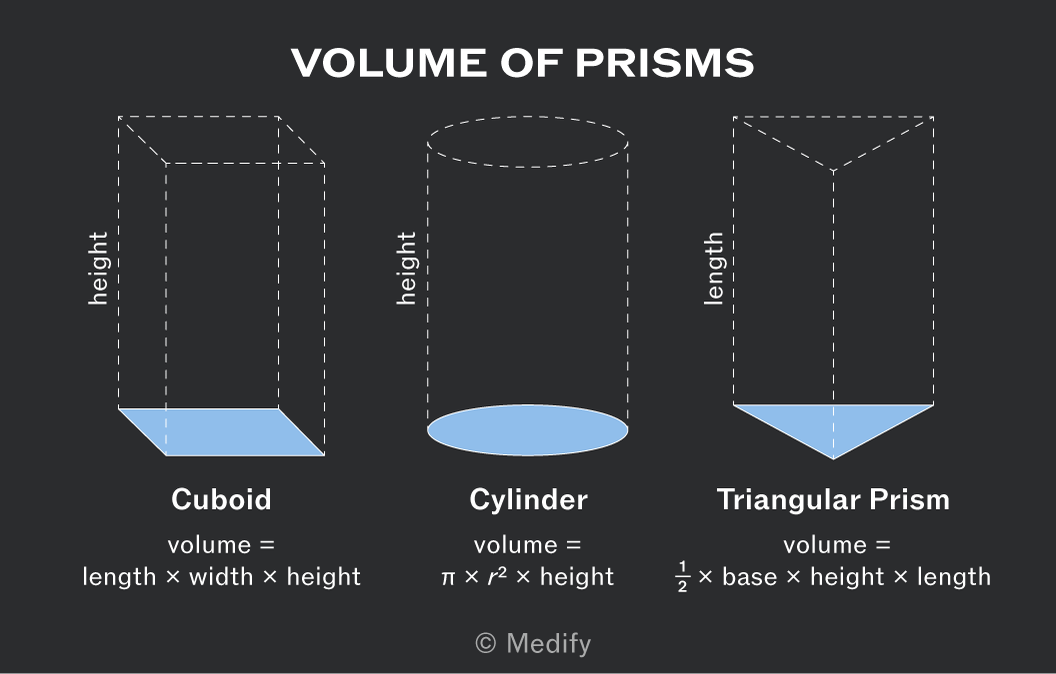
You can save time if you memorise the volume formulae:
- Volume of a cube
- Volume of a cuboid
- Volume of a cylinder
- Volume of a sphere
- Volume of a cone
We think it is unlikely that the UCAT would expect you to know the last two. QR data will tend to include the sphere and cone formulae, but you might learn them as a backup.
A shortcut to remember the cone volume formula: You can fit three cones into one cylinder of the same radius and height. Thus, the cone’s volume is one-third of the cylinder’s volume.
The surface area of a three-dimensional shape is simple to calculate if the 3D shape is a prism.
A prism is a solid shape with a cross-section consistent in size and shape throughout the solid’s height. This cross-section is therefore the prism’s base.
To find the surface area of a prism:
- Use the formula: surface area = 2 × base area + (base perimeter × height)
- Remember to distinguish the bases and double the base area if both bases are included.
- The final part treats the lateral faces of the prism as a single shape that runs the height of the prism.
This approach works for cubes, cuboids and cylinders, as well as any prism with a polygonal base.
We expect the UCAT will tell you the formula for surface area of a sphere or cone as part of the data if you will need it in Quantitative Reasoning.
You could use a shortcut to find the surface area of cubes or cuboids.
In practice, you might calculate the surface area of a cuboid simply by finding the surface area of the three different rectangular faces, then summing and doubling it. This is more of a quick, manual process rather than writing out a formula.
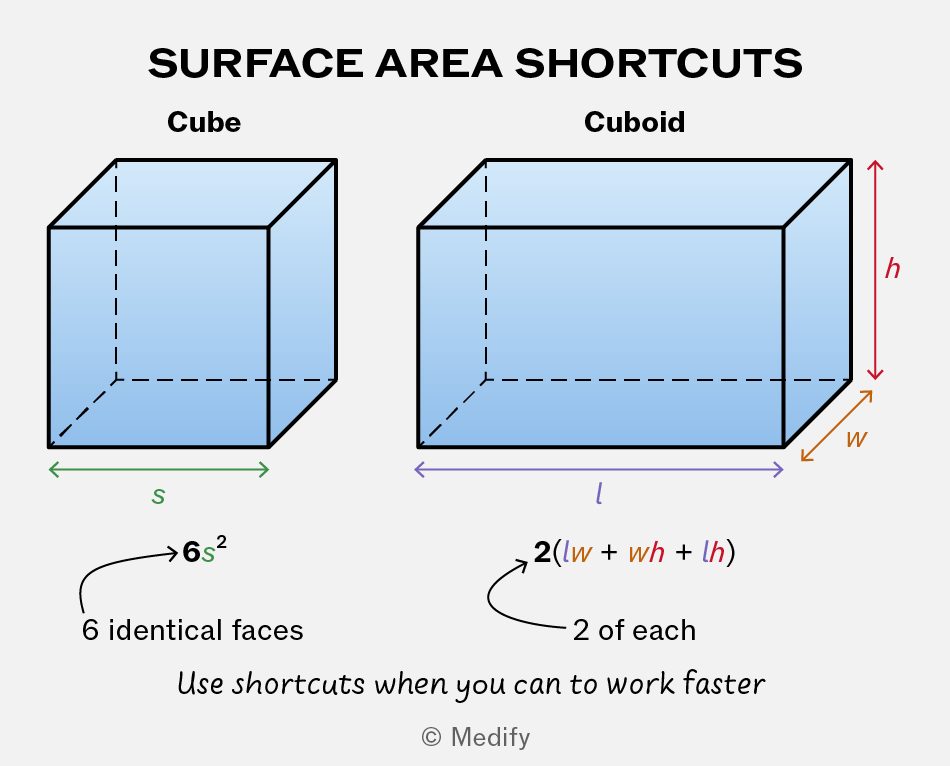
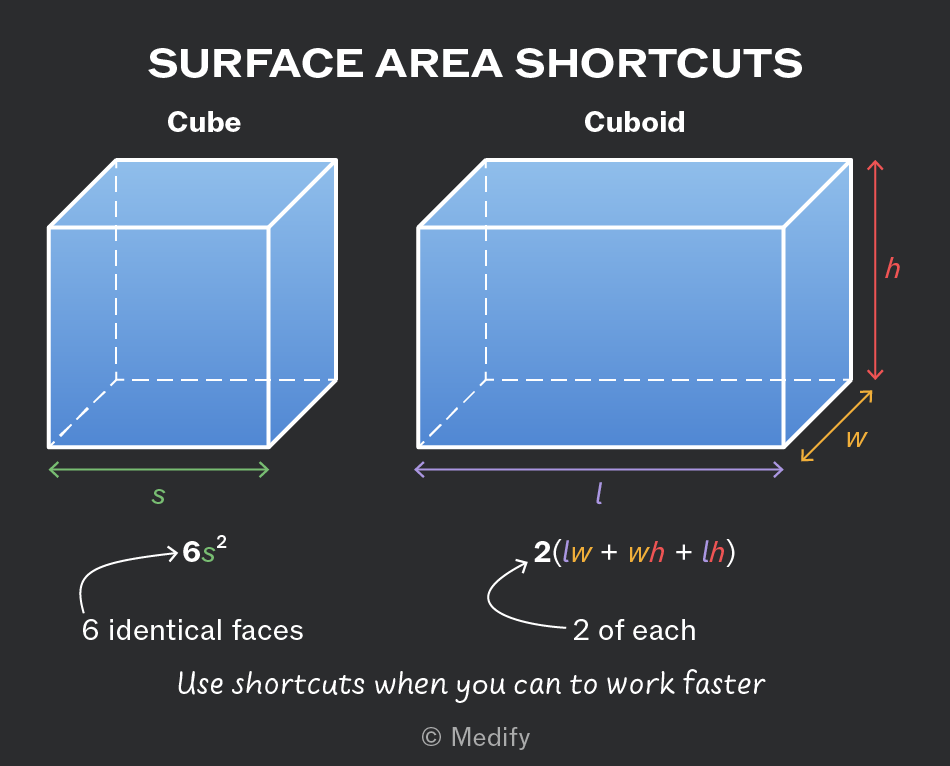
Make sure to set up the steps mentally in a geometry question before you calculate. This will help to save time and minimise errors.
If a geometry question seems time-consuming, decide whether to tackle the question straightaway or flag for review without attempting. Sometimes, if running out of time, you must make a quick guess, perhaps by eyeballing or doing a quick estimation, and click an answer. It’s better than leaving a question blank.