
Percentages
On this page
A percentage is a very common rate format. A percentage turns actual values into parts per hundred.
It may be more useful to think of a percentage in a part of the whole. You could calculate this rate in other formats if you divide to find a decimal or fraction.
But in the UCAT, you will use decimals and percentages in many QR calculations.
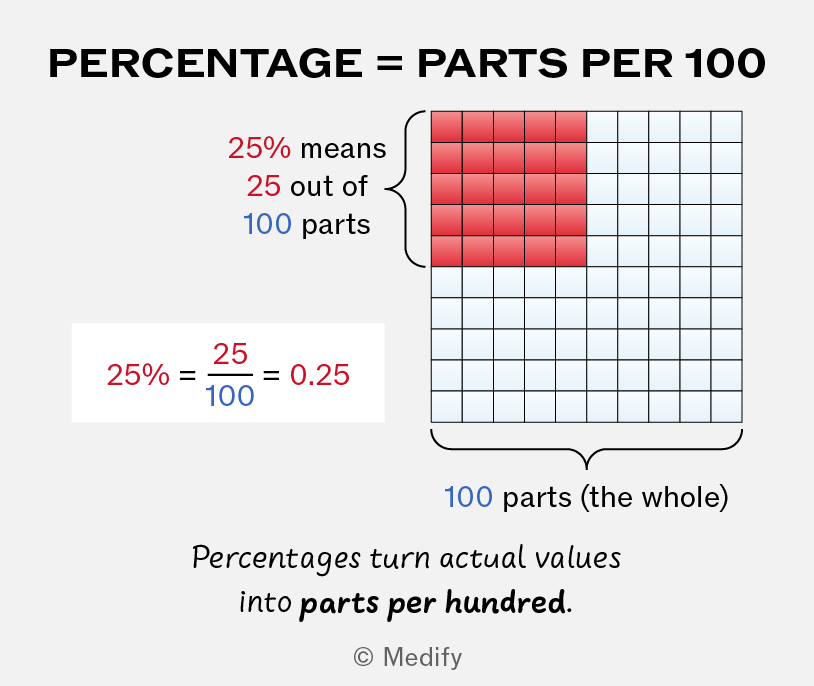
You will work extensively with percentages in the UCAT.
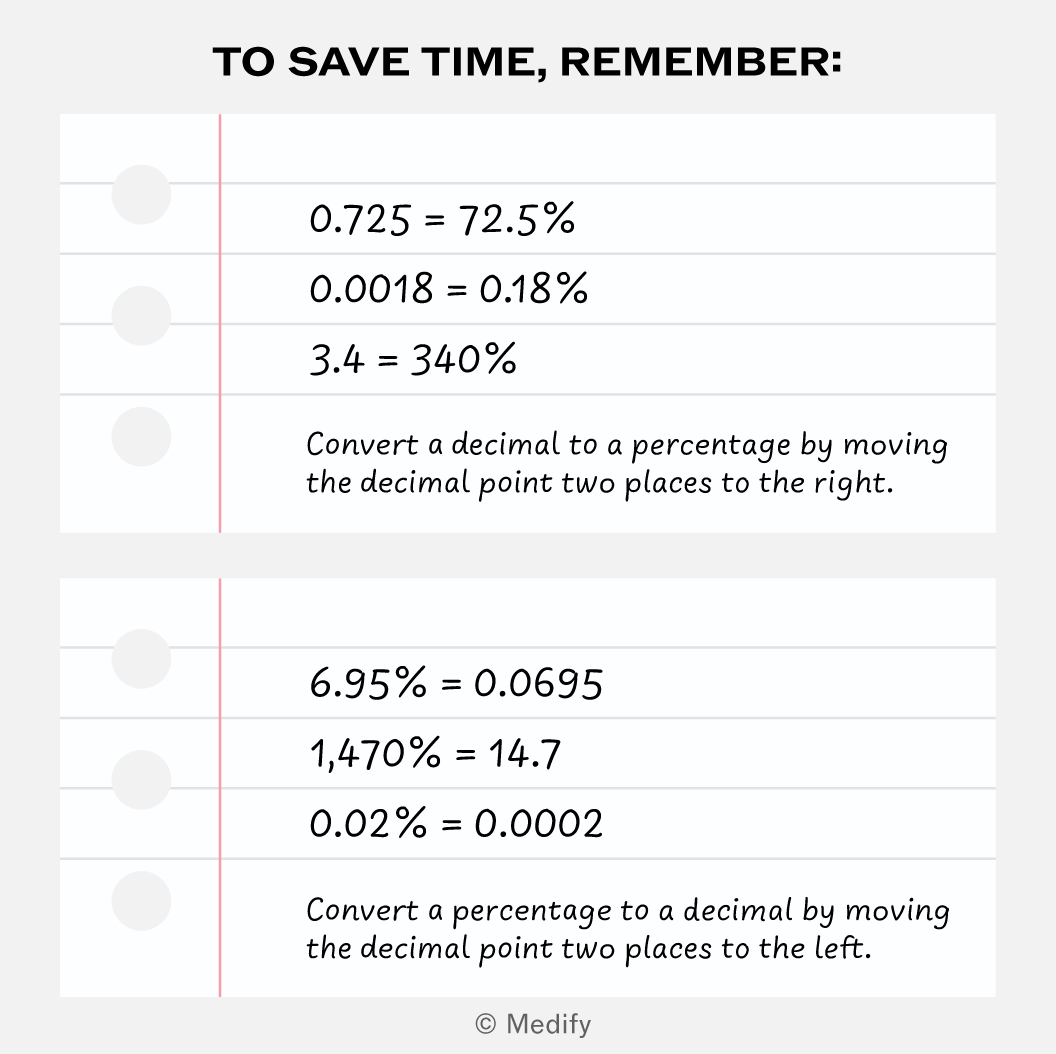
To save time, remember:
- Convert a decimal to a percentage by moving the decimal point two places to the right. Examples: 0.725 = 72.5%; 0.0018 = 0.18%; 3.4 = 340%.
- This is equivalent to multiplying by 100 and adding a percentage sign.
- Convert a percentage to a decimal by moving the decimal point two places to the left. Examples: 6.95% = 0.0695; 1,470% = 14.7; 0.02% = 0.0002
- This is equivalent to dividing by 100 and removing the percentage sign.
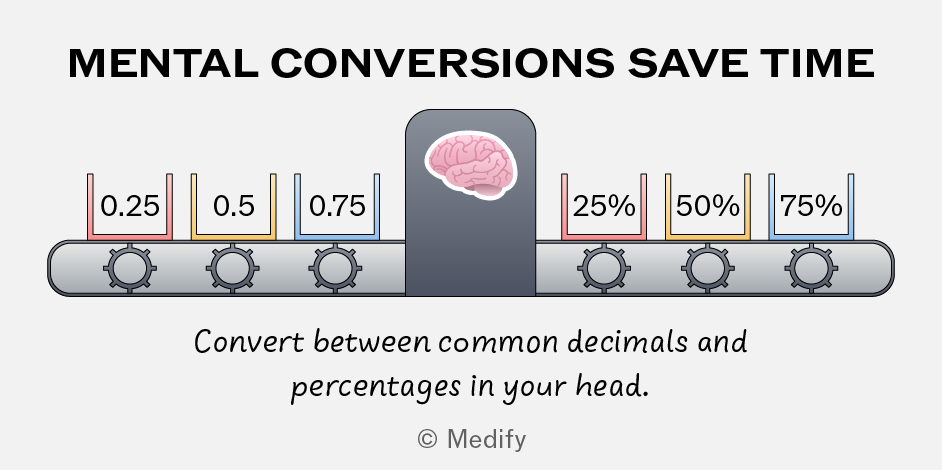
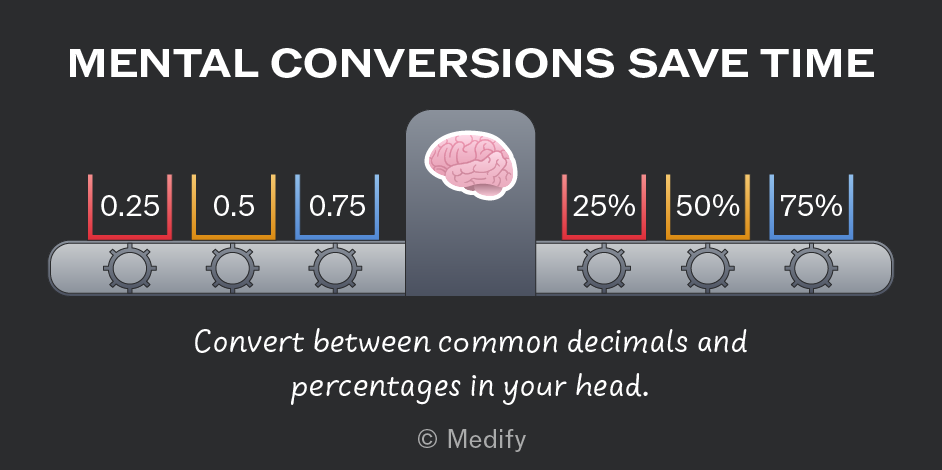
If you can internalise these steps, you will minimise calculations by simply doing them in your head before you go to the answer choices.
Just watch out for wrong answer traps that omit the conversion or do the conversion improperly, which could therefore be off by a factor of 10 or 100.
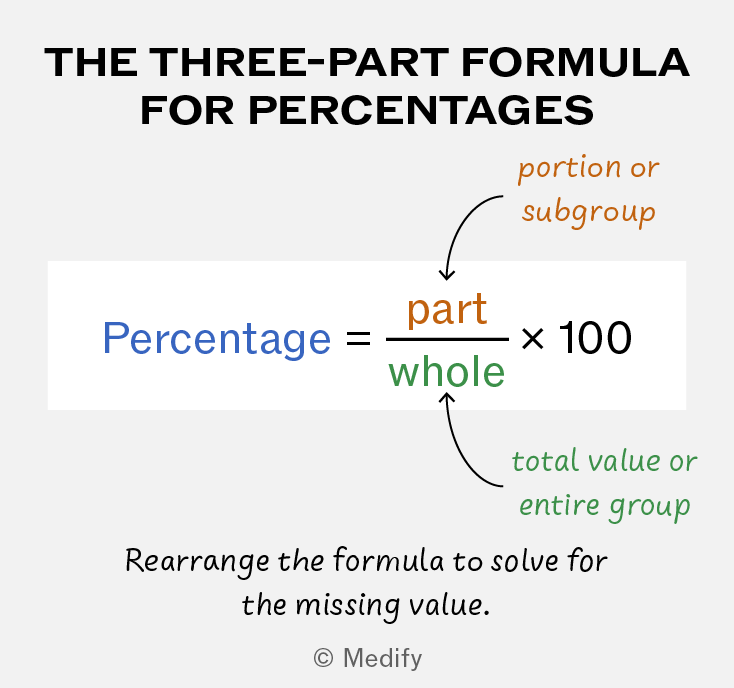
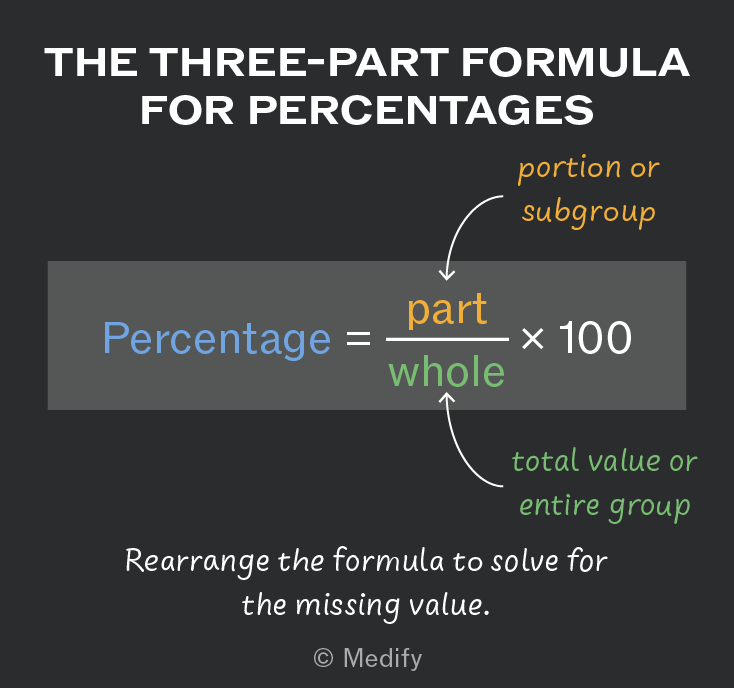
You can use a three-part formula to solve for a percentage.
You can apply this formula in a range of contexts involving percentages. Just take care not to use it when the percentage change formula is required, as that depends on the passage of time as the actual values increase or decrease.
Walkthrough question
Percentage
Let’s use the percentage formula in a QR question.
You can rearrange the percentage formula to solve for an unknown.
You may have to find a new percentage, but you may well have to solve for the part or solve for the whole.Students made 48 cakes for a charity event, only to discover on the day that they took orders for 162.5% of the cakes made. How many orders for cakes did they take?
Here, we are told the number of cakes made, and we need the number of cakes ordered. This is expressed as a percentage of cakes made, so cakes made is the whole, and cakes ordered is the part.
Thus, we can rearrange the percentage formula to solve for the part:
Notice how the percentage formula applies even when the part and whole are less obvious. Think to yourself: what is the main group, or the reference group? The group used as the foundation for the comparison is the whole.
Take care when selecting data to ensure you use the correct part and whole before you calculate.
The UCAT sets wrong answer traps by using incorrect values as the part and the whole. Thus, a likely maths error can lead you to select a wrong answer trap.
You can easily go wrong – even if you are strong at maths – in a few common cases:
- The part and whole are unusual groups, so you might invert them.
- The numbers are super simple so you calculate in your head, only you use a wrong value or invert the values.
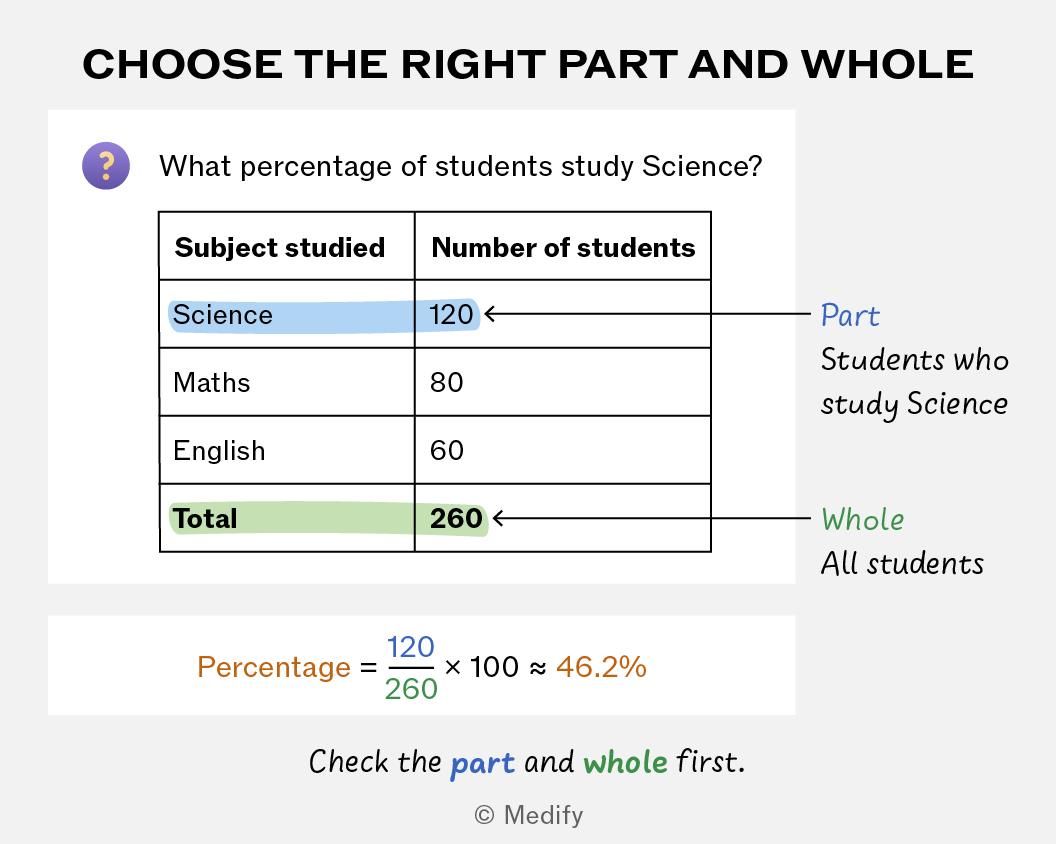
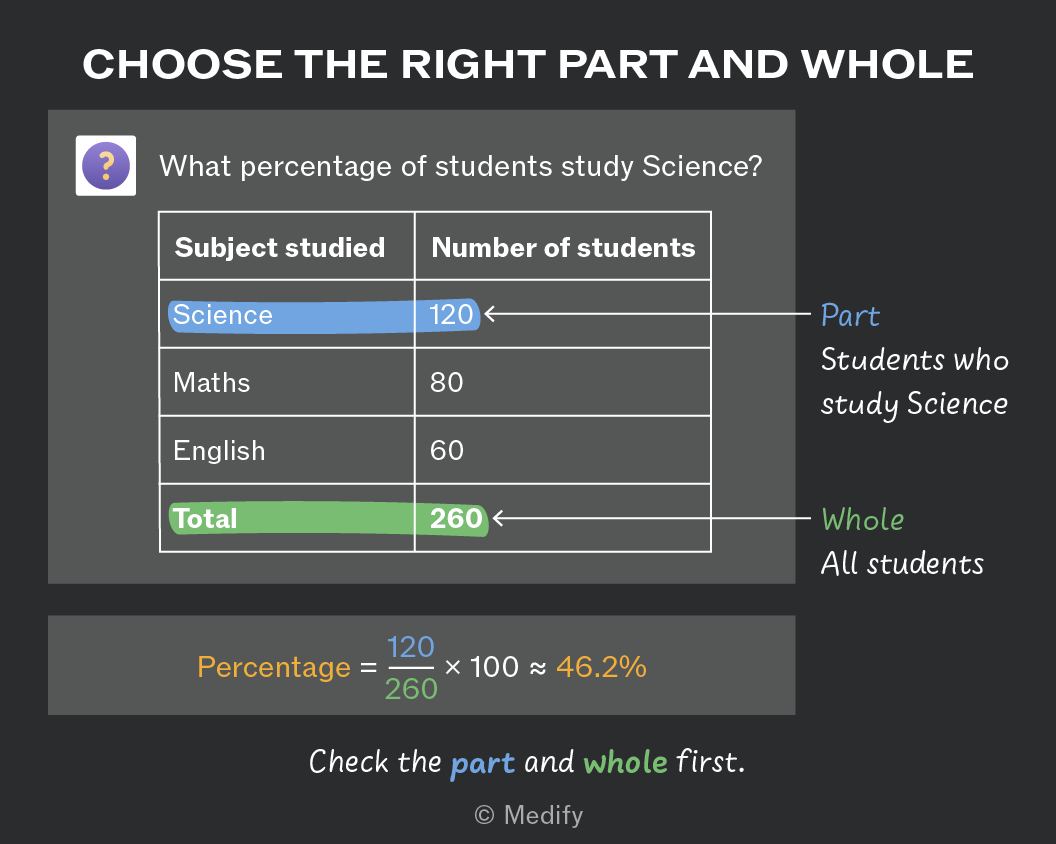
Dividing the part by the whole will give you the percentage in decimal form, which must then be multiplied by 100 to get the percentage.
You will see this step included in QR explanations from Medify and the UCAT Consortium, but you will likely do it in your head to minimise calculator use.
Over the course of the QR section, you can make up several seconds – perhaps even the better part of a minute – by mentally converting between decimals and percentages.
Walkthrough question
Percentage
Now, attack another QR question using the percentage formula.
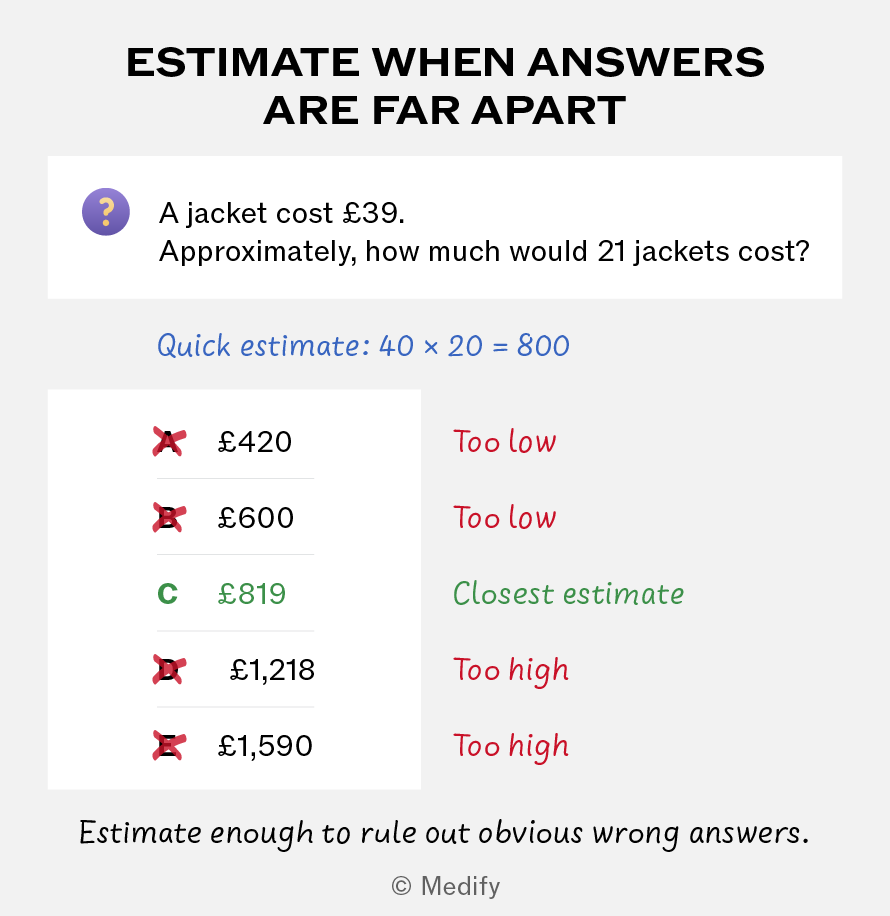
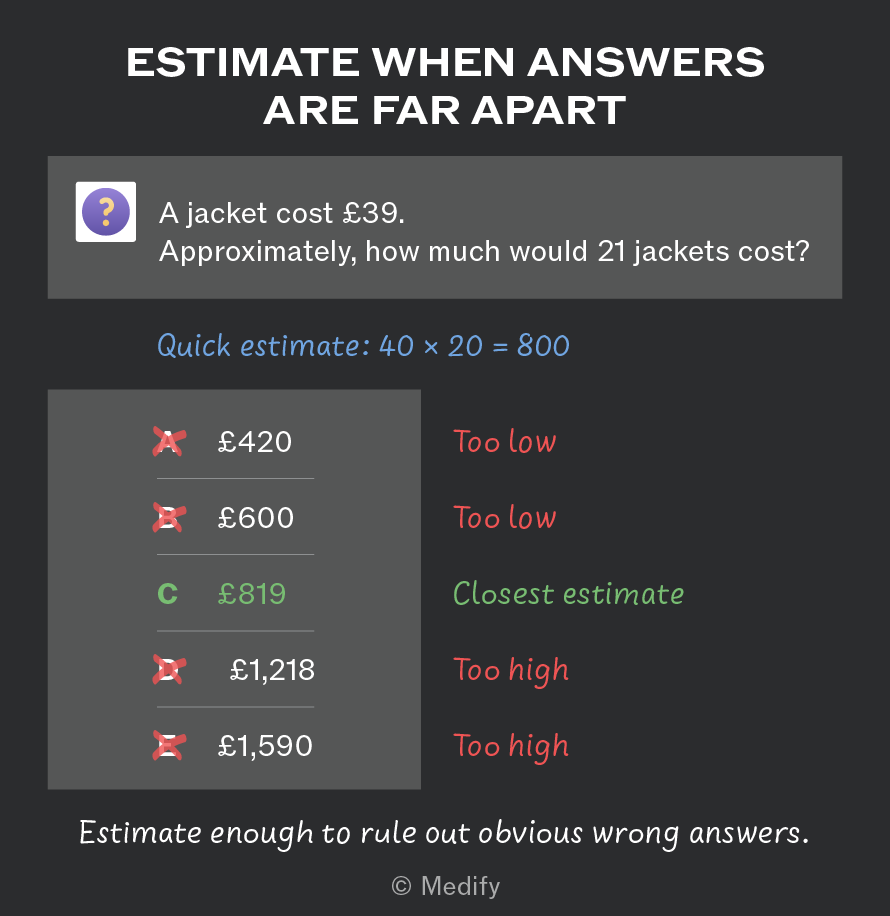
Before calculating, look at the answer choices. If they are far apart, a rough estimate may be enough to identify the correct answer or eliminate options that are clearly too large, too small, or out of scale.
If the answer choices are close together, estimation is risky. In that case, calculate carefully, then confirm and click your answer.
When time is short, estimation can help you keep moving. Eliminate any obviously incorrect answers and make the most informed choice you can.
If you answer using estimation without fully calculating, flag the question for review and return to it if time allows.
If there is no time to return, choose your best answer rather than leaving the question blank.
Walkthrough question
Estimating a percentage
Let's try using estimation to tackle this QR question.